
Top 15 Most Spoken Languages In The World
There are currently 7.7 billion people on Earth and no less than 7,139 living languages worldwide. But what are the most spoken languages in the
Interslavic language explained. Learn about mutual intelligibility between Slavic languages.

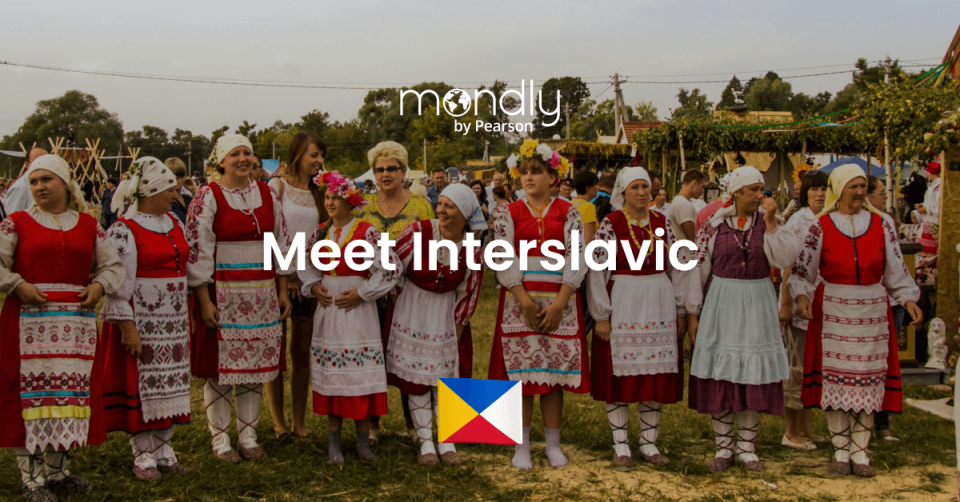
Many speakers of Slavic languages such as Polish, Bulgarian or Serbian have had the experience of their language being mistaken for Russian. “It sounds exactly like Russian!” or even “They all sound like Russian!” a speaker unfamiliar with Slavic languages would insist. To an untrained ear it may be so, however, the speakers of these languages don’t naturally know much of Russian. As a native Pole, I also speak from personal experience. There are, however, other Slavic languages that I have the ability to understand better. In fact, I feel occasionally distressed while listening to Czech and Slovak. They sound very familiar to me and yet I understand them only to some extent. Why is it easy for Slavic native speakers like me to comprehend some languages and not others?
It all depends on how closely the languages in question are related. Broader language families, such as the Indo-European family, are divided into language subfamilies (often referred to as groups for simplicity) such as Slavic languages. They’re then divided into groups and once again into subgroups (I know!).
Within Slavic languages, Czech and Slovak are very closely related. They even come from a linguistic subgroup called…Czech–Slovak. You could think about these two languages as siblings. There’s a fair amount of mutual intelligibility, with a side note that the degree to which this is true for speakers may vary for cultural and generational reasons.
If we then compare Polish to them, we’re dealing with a more diluted relationship. Think of it as a cousin. And just how brothers and sisters usually look more alike than cousins, Czech and Slovak are more similar than Polish and either of these languages. Still, all of them belong to the West Slavic language group, which is why they show a fair amount of similarities. Just have a look at some examples:
| English | Czech | Slovak | Polish |
|---|---|---|---|
| Sun | slunce | slnko | słońce |
| tea | čaj | čaj | herbata |
| door | dveře | dvere | drzwi |
Apart from the West Slavic group, there are also East Slavic and South Slavic languages. And all of them also have subgroups, of course! Can people who speak Slavic languages understand each other, when the languages come from different groupings? To a limited extent. There’d be some words or expressions that would be alike, as well as some grammar concepts. However, there’d also be many false friends; words that sound or look similar but mean a very different thing. For example, the Polish word czaszka means “a skull”, while the Russian чашка (chashka) means “a cup”. Just imagine a tea party and misunderstandings about crockery used that could emerge…
To summarise, as much as Slavic languages are all related and share roots, they remain distinctively different. This linguistic diversity that we can see in the region is really impressive and a positive thing. When it comes to practical matters, however, such as easy communication between Slavs, it can cause issues. This is why a special language was created. One that most Slavic speakers can understand fairly well without prior knowledge or ever studying it. Say hello to Interslavic!
Briefly explained, Interslavic is an artificial language created to foster communication between speakers of different Slavic languages. Its first name was Slovianski. The language has been constructed, but it’s not entirely artificial. It’s partially based on Old Church Slavonic, which was a language used in church writing and is still present in many Orthodox churches. Interslavic’s goals are much broader, as it’s striving for enhanced communication between all people with Slavic heritage and speakers of Slavic languages.
The type of language that Interslavic is, is often referred to as conlang, with “con” being an abbreviation of “constructed”. You may not have heard about this Slavic conlang, but the name Esperanto likely rings a bell. If not, then let’s just say it’s a much more famous artificial language created to allow better communication between all people in the world. With much bigger and more universal ambitions, Esperanto has become a constructed language with the biggest number of users. It still loses the race (by far!) with the English language, which has become the lingua franca of the modern world.
It is true that in comparison to Esperanto, Interslavic has a much smaller appeal. This isn’t the only reason for its fame. With its history dating all the way to 1887 and the work on the project of creating a common language for speakers of Slavic languages only starting in 2006, it’s also not an entirely fair competition. Esperanto has had a 119-year head start, after all. There’s definitely a growing interest in how Interslavic connects Slavic speakers, allowing them to celebrate their common heritage. Because, hey, we may be proud of our national identities, but two Slavs abroad often become quick friends. Communicating in English or another language as an intermediary feels artificial to some of us.
The idea behind the Slavic lingua franca was never to replace real Slavic languages. The lingo was constructed on the basis of common traits of these languages, so it naturally differs in all sorts of ways from typical languages. The grammar of Interslavic is simplified, while languages emerging naturally tend to have a complex grammar and lots of exceptions (ask anyone who’s studying Polish!). Interslavic also has no natural constructions coming from regionalisations, no borrowed forms and no varieties that are evolving. There are no idioms and there’s no slang, nothing that expresses how people convey subtleties through language. Perhaps most importantly, it has no native speakers. Even the answer to whether anyone speaks Interslavic fluently isn’t hopeful, as most people in this group are either the creators of the language or those otherwise heavily involved in the project.
There are many reasons why language enthusiasts are interested in this constructed language. A new language is always fascinating, to us, linguistic fanatics. With all my cheerleading for this project, however, it has its limitations. It’s true that the language can be understood by many. The interest in it is growing, and hopefully one day it’ll become an alternative to learning each Slavic language separately. Nonetheless, comprehension is but a part of the language and with very few people capable of expressing themselves in Interslavic, it’s not a good communication tool. At the moment, the answer to the question “Who uses Interslavic and why?” is limited to aficionados of this group of languages, specifically.
I wouldn’t say so. It’s not a great intro to Slavic languages. Knowing Interslavic, as is the case with any other Slavic language, would be a way of making it a bit easier to learn another language from the same group. However, it’d be even easier… to simply learn the required language to start with. In other words, if you want to learn Russian or Polish, just learn these languages. Real Slavic languages can be used to speak to millions of people.
Interslavic would be a nice step for someone who already has a few Slavic languages under their belt or who loves learning languages for fun. It’s also entertaining for Slavic language learners to listen to it or read something written in it. If you already speak one of the Slavic languages, go for it. Be careful, however, to remain focused on your target language, as too much of a good thing may cause issues. While it’s easier to learn another language from the same group, learning multiple languages that are similar can also be confusing and slow down the process. In brief, the pan-Slavic conlang is a great tool for connecting Slavs, but probably not the best use of your time otherwise.
Slavic languages are gaining popularity among language learners worldwide. While Interslavic may not be the best choice to start with, Mondly offers courses in six different real languages from this group! Did you know that you can start learning Russian, Polish, Czech, Croatian, Ukrainian or Bulgarian for free? Download your Mondly app or use your computer to gain access to these languages any time, anywhere.


There are currently 7.7 billion people on Earth and no less than 7,139 living languages worldwide. But what are the most spoken languages in the

Language learning myths prevent people from even trying to learn a new language. Here are the most common myths about language learning.

Just downloaded Mondly and you are not sure how to get started yet? Then this step-by-step guide is for you.